Asset-based lending
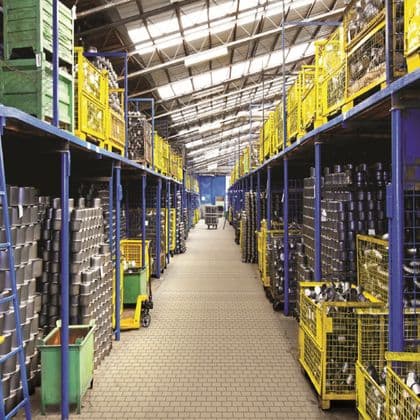
Borrowing against what the business already owns — invoices, stock, equipment — which is why it usually prices better than anything else we place.
- Amount
- $50,000 – $2,000,000
- Term
- Revolving or fixed
When it fits
- You have real receivables, inventory or equipment on the balance sheet.
- The amount you need is larger than an unsecured lender would write.
- You can produce an aging report, a stock list or an equipment schedule.
When it does not
A young business with few assets and strong deposits will usually get further, faster, with a term loan or a line of credit.
What it looks like
- What arrives
- An advance against the assets, drawn or in one go
- What leaves
- Repayment as the assets convert — invoices paid, stock sold
- Security
- Registered against the assets it is advanced on
- Review
- Ongoing: the facility follows the asset base
Expect to be asked for more than the standard file: an accounts-receivable aging, an inventory listing, or a schedule of the equipment, depending on what is being lent against.
What you still owe
Cleared as it converts
Advanced against something you already hold, and cleared as that asset turns back into cash.
Drawn over a full term. Illustrative — your amount, term and payments come from the offer.
What people get wrong about it
- It is a last resort.
- It is usually the least expensive of the four, because the lender's exposure is covered by something real. The cost of money tracks risk, and this is the lowest-risk shape we place.
- Pledging receivables means handing over your customers.
- In most structures you keep collecting and your customers notice nothing. Where a lender does want notification, you will be told before you sign, not after.
- It is quick, like the others.
- It is the slowest of the four, because there is an asset to document and value. If you need money this week, this is not the one — and we will tell you that.
What people spend it on
- Unpaid invoices that are good but slow
- Stock sitting on a shelf before a season
- Equipment you own outright
- A number bigger than an unsecured lender will write
Pick this when you own something real. It usually prices better than anything else here, and it takes longer to put in place.
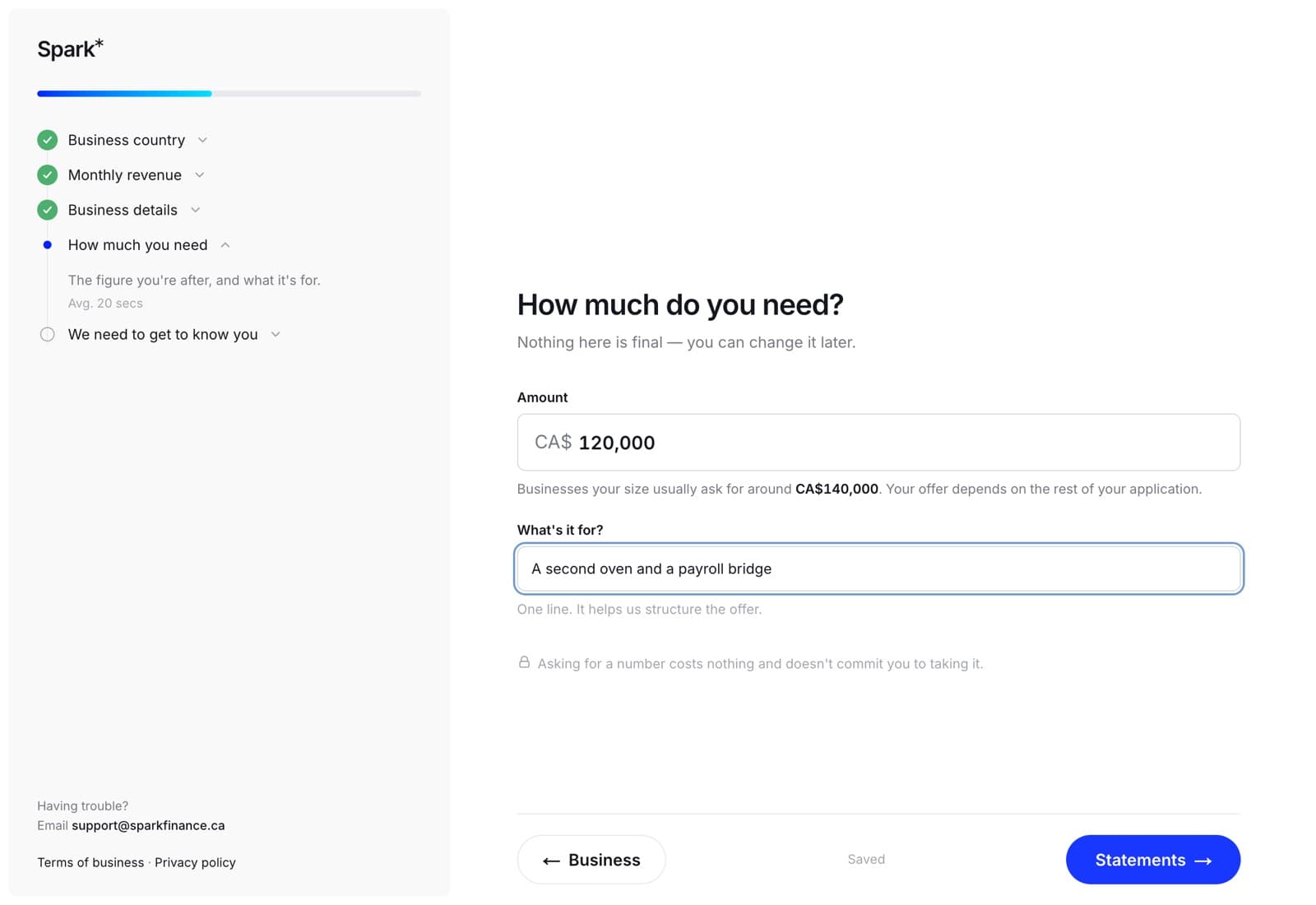
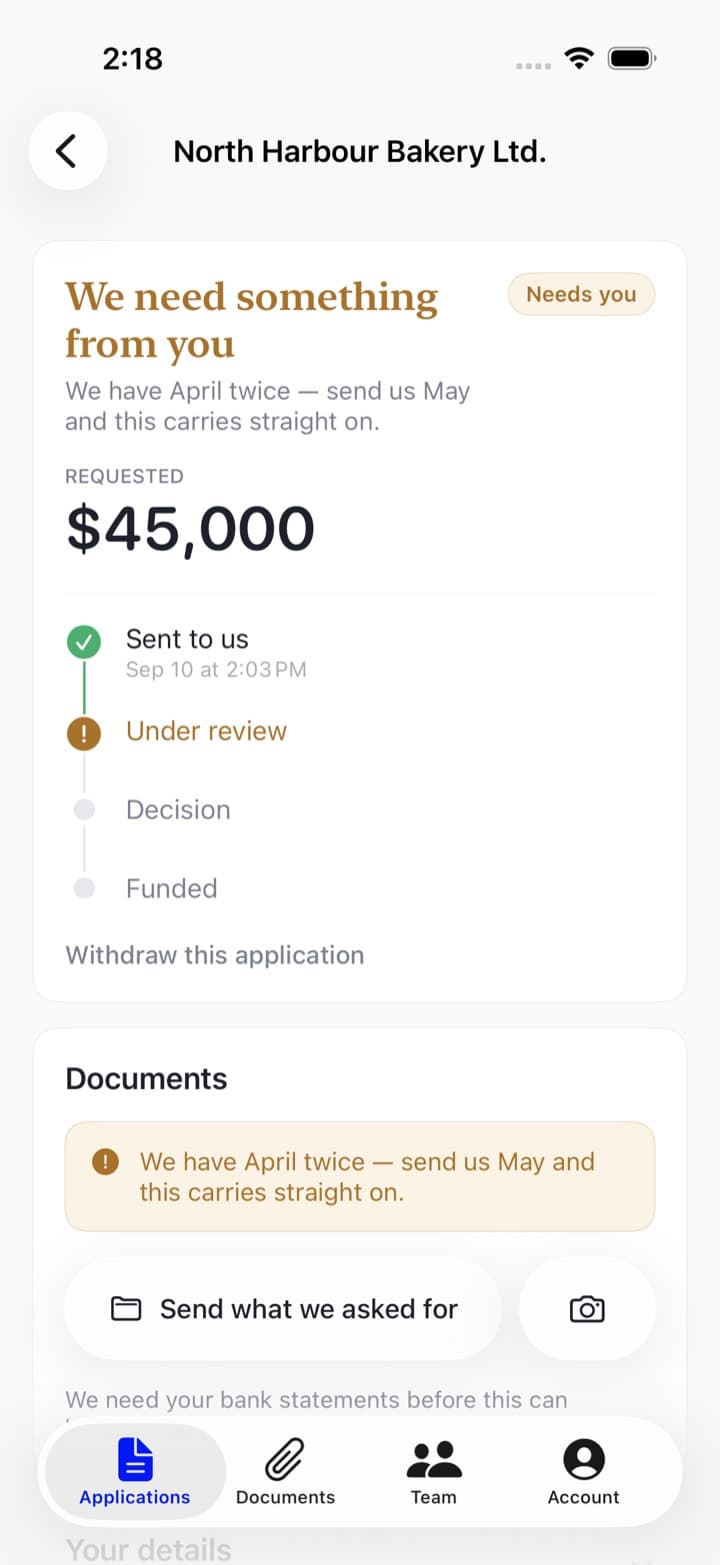
Start on a laptop, finish on your phone
You say how much you need and what it is for. The same file reaches the lenders most likely to fund it, and it saves as you type.
How to get one
Five steps. About ten minutes, most of it finding your statements. One file goes to the lenders most likely to fund it — you don't apply four times.
- 1Make an accountBusiness email, name, phone, password. Two minutes.
- 2Answer eleven short questionsWhere you are based, what you bring in, how much you need. It saves as you type.
- 3Send six months of bank statementsPDFs from your bank. This is the part underwriters read.
- 4Add your paperwork and verify your IDIncorporation documents, the owners, and a photo of your licence.
- 5Send itMost decisions come back within one business day.
This one against the other three
You don't have to pick — send one application and we come back with the one that fits. But if you are weighing them up, this is how this one differs from each of the others.
This is usually cheaper and always slower. The trade is documentation: there is an asset to schedule and value. If the money is needed inside a week, take the term loan.
- Amount
- $5,000 – $2,000,000
- Term
- 6 – 60 months
Both revolve, but a line is sized against revenue and this is sized against what you can pledge — which generally means a bigger facility at a lower cost, in exchange for more paperwork.
- Amount
- Up to $500,000
- Term
- Revolving
Equipment financing is this, narrowed to the machine you are buying. This is the version for things you already own: invoices, stock, equipment that is paid for.
- Amount
- $10,000 – $1,000,000
- Term
- 12 – 72 months
What it costs
In dollars, before you sign. The amount. The total you'll repay. The payment. How many payments. Multiply the last two and you're back at the total — that's the whole of it.
No rate to compound out yourself. Read the agreement for the fees the lender charges. If a number on an agreement isn't obvious, call us before you sign it. That's what we're for.
The trade here is time. The asset has to be identified, documented and valued, and that takes longer than the other three — which is the price of it being the cheapest of the four.
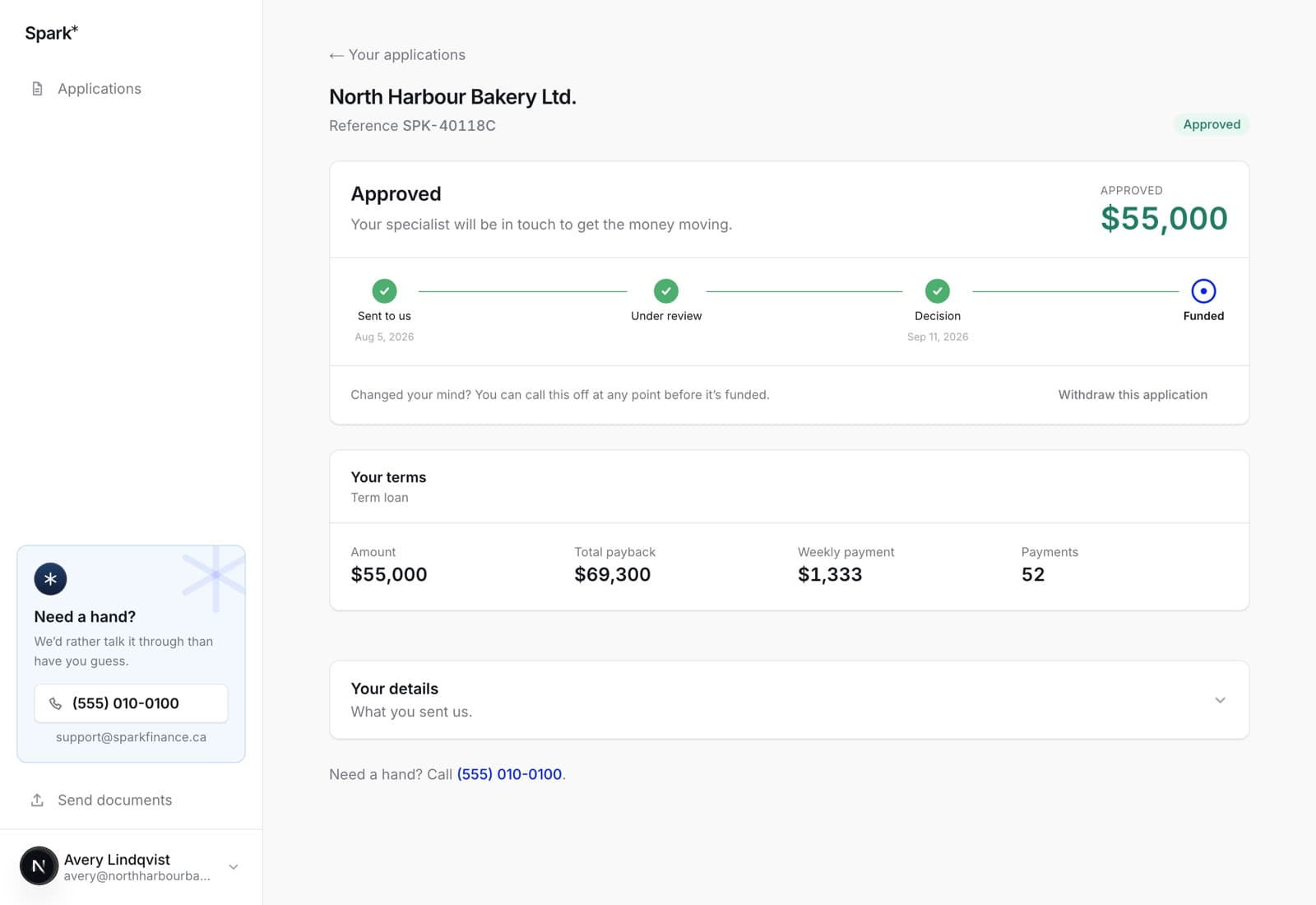
An approved application. Amount, total payback, payment, number of payments — the four figures, before anything is signed.
What we need to place it
The same file whichever of the four it turns out to be. Most of the ten minutes is finding the statements, which is why it is worth doing first.
There is an asset to value here, so this is the slowest of the four to arrange — and usually the cheapest once it is.
- Six months of bank statementsPDFs from your bank, every account the business uses
- Your incorporation paperworkWhatever your province or state issued
- Anyone who owns 25% or moreName, email, and a rough percentage
- One ID checkAbout thirty seconds, and never again
- An accounts-receivable agingWho owes you, how much, and how long it has been outstanding
- An inventory list or equipment scheduleWhatever is being lent against, with values
Questions
No. They stay yours and stay in use. Security is registered against them, which is what a lender relies on if the facility is not repaid.
Still deciding? Talk to a specialist — no application required.
Worth reading next
- GuideWhat working capital actually costsHow to read a funding offer in dollars instead of rates, and the three numbers that decide whether it is worth taking.
- WritingWhat changed in Canadian small business lending this yearBank credit tightened, alternative funding filled the gap, and the cost of not reading the terms went up.
The other three
- Term loansA fixed amount, a fixed schedule, and nothing pledged against it. The straightest answer when you know the number and the timeline.
- Revenue-based line of creditDraw what you need, pay for what you draw, and the limit moves with your revenue. For months that are uneven, not short.
- Equipment financingThe oven, the van, the line. Financed against the thing itself, so the payment sits against what the thing earns.
See what you qualify for.
About ten minutes, most of it finding your statements. Applying never touches your credit score.