Revenue-based line of credit
A limit you can draw against and pay back as the month allows, sized against what actually goes through your account.
- Amount
- Up to $500,000
- Term
- Revolving
When it fits
- Revenue is seasonal, or lumpy, and the problem is timing.
- You want cover for a slow month without borrowing for the whole year.
- Payroll lands before the receivables do.
When it does not
If you know the number and the date, a term loan is usually cheaper: a facility you keep open has a cost even in the months you do not use it.
What it looks like
- What arrives
- A limit. You draw what you need, when you need it
- What leaves
- Repayment on what you have drawn, not on the limit
- The limit
- Reviewed against revenue — it moves as the business does
- Term
- Revolving: it stays open while it is in good standing
What you still owe
Repay when the money lands
You draw when you need it and pay it back when the money lands. You only ever pay for what is out.
Drawn over a year of ordinary trading. Illustrative — your amount, term and payments come from the offer.
What people get wrong about it
- The limit is the amount you are borrowing.
- It is the ceiling, not a balance. An unused limit costs nothing, which is the whole point of the product — and it means comparing a line to a term loan on headline size compares nothing.
- A bigger limit is always better.
- The limit counts against what you can carry in total, so a line larger than you will use can crowd out the equipment finance you need in eight months.
- Drawing on it looks bad.
- Drawing and repaying on a rhythm is exactly what it is for, and a line used that way reads well. A line drawn to the ceiling and held there does not.
What people spend it on
- Payroll in the week before the receivables land
- Stock for a season you can already see coming
- A quiet month that you know is one month
- Keeping supplier terms instead of stretching them
Pick this over a term loan when the problem is timing, not total. You only pay for what you draw.

Start on a laptop, finish on your phone
You say how much you need and what it is for. The same file reaches the lenders most likely to fund it, and it saves as you type.
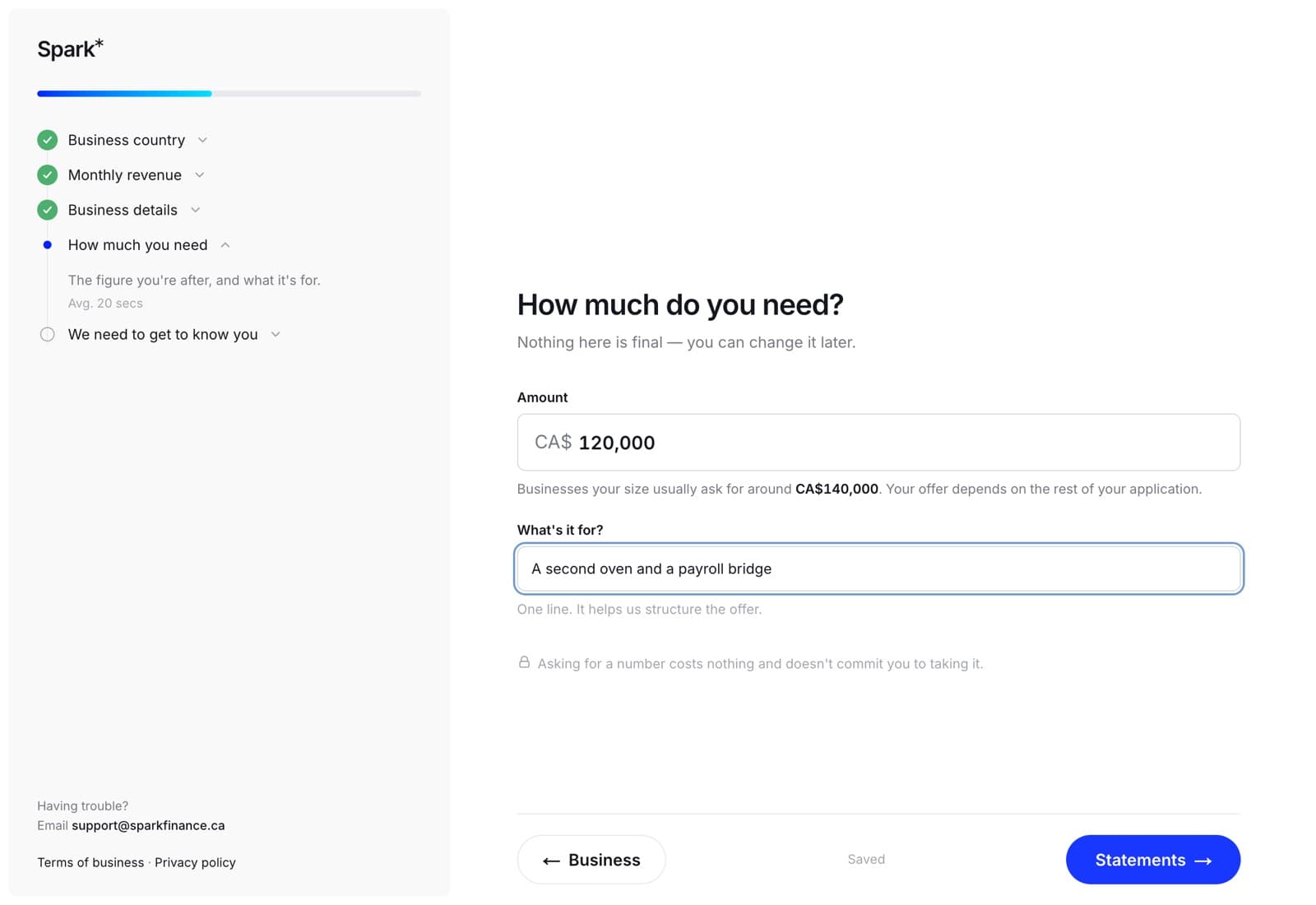
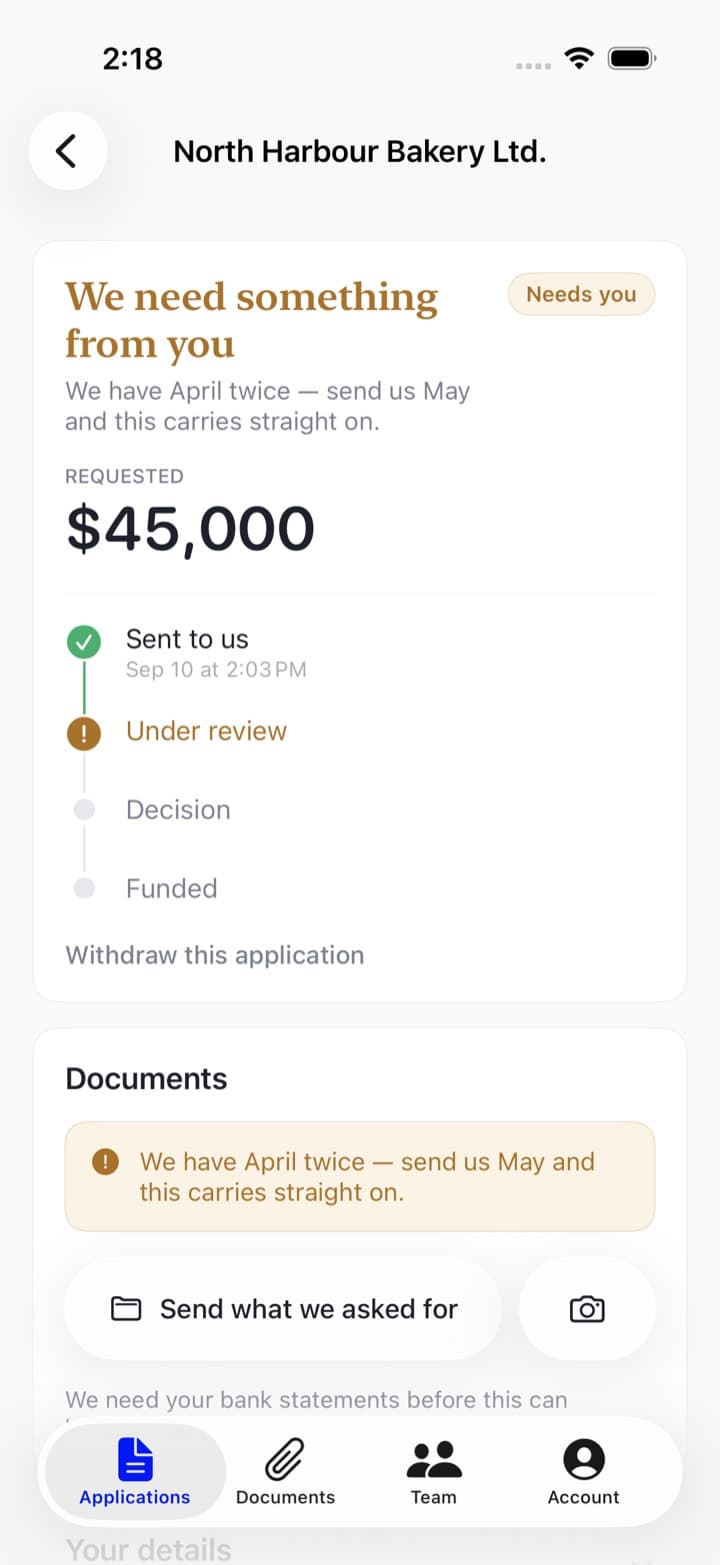
How to get one
Five steps. About ten minutes, most of it finding your statements. One file goes to the lenders most likely to fund it — you don't apply four times.
- 1Make an accountBusiness email, name, phone, password. Two minutes.
- 2Answer eleven short questionsWhere you are based, what you bring in, how much you need. It saves as you type.
- 3Send six months of bank statementsPDFs from your bank. This is the part underwriters read.
- 4Add your paperwork and verify your IDIncorporation documents, the owners, and a photo of your licence.
- 5Send itMost decisions come back within one business day.
This one against the other three
You don't have to pick — send one application and we come back with the one that fits. But if you are weighing them up, this is how this one differs from each of the others.
A term loan is the better answer when there is a number and a date. A line is for the months, not for the purchase — draw, repay, draw again, and pay only for what is out.
- Amount
- $5,000 – $2,000,000
- Term
- 6 – 60 months
Both revolve. The difference is what sets the ceiling: a line is sized against your revenue, an asset-based facility against something you can pledge, which usually makes it larger and cheaper and slower.
- Amount
- $50,000 – $2,000,000
- Term
- Revolving or fixed
Never buy a machine on a line if equipment financing is available. The machine secures its own loan and prices better; using the line for it just consumes the headroom you keep for the quiet months.
- Amount
- $10,000 – $1,000,000
- Term
- 12 – 72 months
What it costs
In dollars, before you sign. The amount. The total you'll repay. The payment. How many payments. Multiply the last two and you're back at the total — that's the whole of it.
No rate to compound out yourself. Read the agreement for the fees the lender charges. If a number on an agreement isn't obvious, call us before you sign it. That's what we're for.
A line is the one product where the cost is partly yours to set, because you only pay for what is drawn. That also makes it the easiest to compare wrongly: judge it on what you will actually have out in an average month, not on the limit.
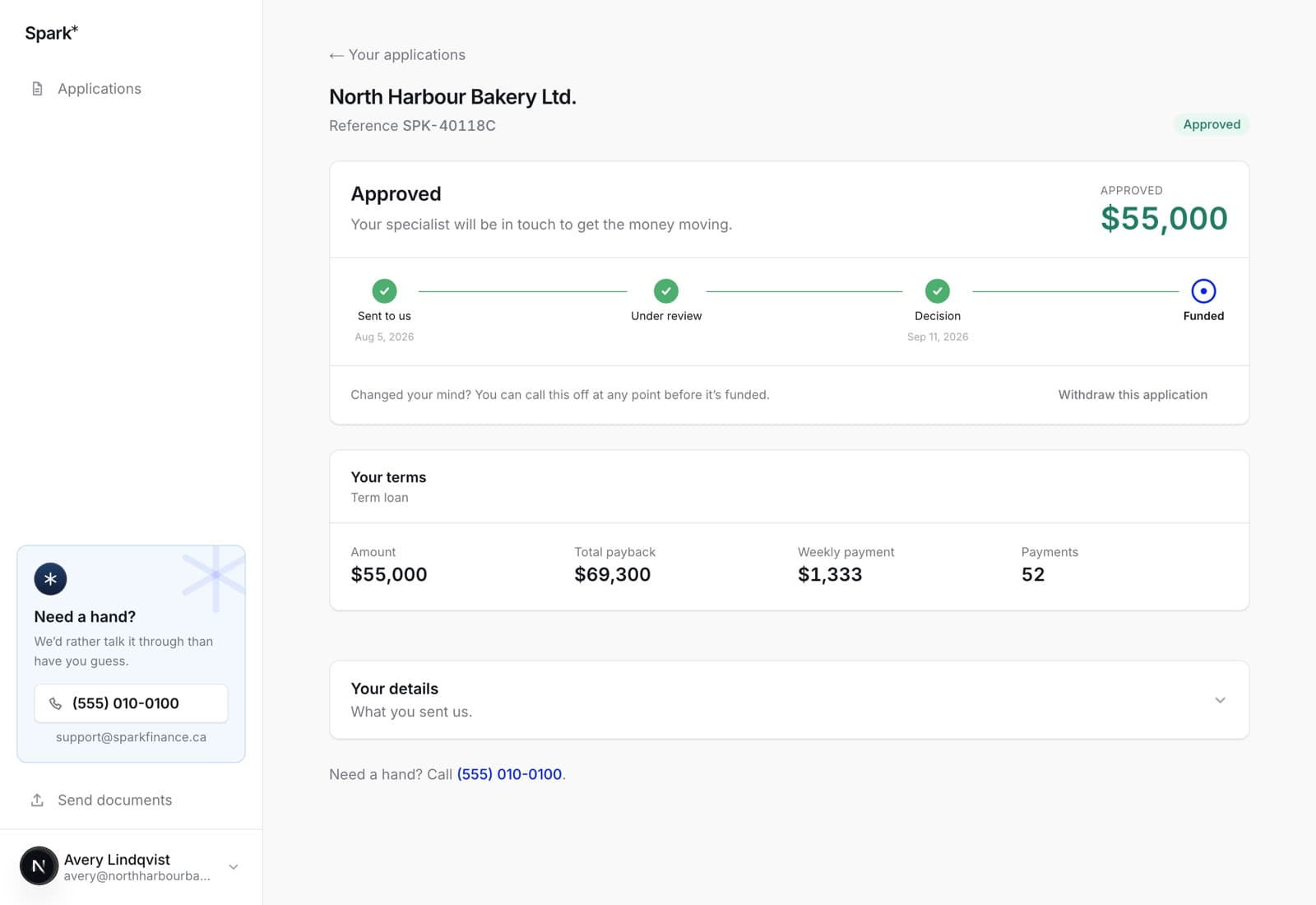
An approved application. Amount, total payback, payment, number of payments — the four figures, before anything is signed.
What we need to place it
The same file whichever of the four it turns out to be. Most of the ten minutes is finding the statements, which is why it is worth doing first.
A limit is set against your revenue rather than against a purchase, so there is nothing to quote and nothing to value.
- Six months of bank statementsPDFs from your bank, every account the business uses
- Your incorporation paperworkWhatever your province or state issued
- Anyone who owns 25% or moreName, email, and a rough percentage
- One ID checkAbout thirty seconds, and never again
- How uneven the months actually areThe statements show it, but a line about your season saves a question
Questions
That depends on the facility, and the honest answer is that some carry a fee for being open and some do not. It is the first thing to ask about any line you are offered.
Still deciding? Talk to a specialist — no application required.
Worth reading next
- WritingAn advance or a line of credit?They solve different problems. Which one fits a one-off purchase, and which fits an uneven month.
- GuideHow much can my business actually borrow?Why the number comes from your deposits rather than your revenue, and the four things that move it up or down.
The other three
- Term loansA fixed amount, a fixed schedule, and nothing pledged against it. The straightest answer when you know the number and the timeline.
- Asset-based lendingYour receivables, inventory or equipment doing some work while you still hold them. Security usually prices better than an unsecured facility.
- Equipment financingThe oven, the van, the line. Financed against the thing itself, so the payment sits against what the thing earns.
See what you qualify for.
About ten minutes, most of it finding your statements. Applying never touches your credit score.