Financing for restaurants
Card settlement is daily and predictable, which reads well. Rent, food cost and payroll are relentless, which is usually what the money is for.
How the money reads
An underwriter reads six months of statements. This is what yours usually says.
- Card processors settle daily or every few days, so deposits are frequent and steady.
- Cash sales, where they exist, have to be deposited to count — an underwriter reads the account, not the till.
- Seasonality is normal and expected: a patio summer and a quiet February do not read as a problem.
Money comes in every single day, which reads well. Rent lands in one piece on the first, and food and payroll never stop — so a good month and a tight month can look the same by the 28th.
The thing that slows these files down
Multiple locations under multiple accounts need all of the accounts. A file with one location's statements reads as a much smaller business than the one applying.

What it usually pays for
- Equipment — an oven, a walk-in, a hood
- A build-out, or a second location
- Bridging a slow month without touching supplier terms
What an underwriter asks
The same four things decide every file: revenue and how long you have been making it, the cash cushion, bounced payments, and what you already pay other lenders. Here is what those look like in this trade.
- What is the daily balance, not the monthly total?
- A room can turn over a lot and still end most days near zero. The cushion is measured as the average daily balance against a month of revenue, and it is the figure that separates two restaurants with identical sales.
- Is every location in the file?
- Two rooms under two accounts read as one small restaurant if only one set of statements arrives. Send all of them, including the account that only pays suppliers.
- What already comes out for other lenders?
- Daily-remittance advances are common in food service and they show in the statements from the first page. Each one takes up part of the room you have left.
- 1Revenue, and how longThe monthly average, and the years behind it
- 2The cash cushionAverage daily balance, against a month of revenue
- 3Bounced paymentsNSF and returned items over ninety days
Totalled against monthly revenue and capped at 20% — the ceiling we pre-qualify to. This is the one that binds: two advances already running leaves less room than none, however good the rest looks.
The split shown is an example, not your file. Yours is read by a person, from your own statements.
Asking for the right amount
A month of revenue is the anchor. For a build-out, ask for what the build-out costs rather than a round number — a quote attached to a concrete use gets read faster than a larger ask with nothing behind it.
Across every trade the anchor is the same: roughly a month of revenue, and never more than the statements support. What you already pay other lenders matters as much as what you are asking for, and you need an average of at least $20,000 a month to qualify at all.
When to ask
Apply before the season you are funding, not during it. A patio build needs the money in March, and a file sent in June is competing with your own busiest weeks for the attention it needs from you.
Have these ready as well
On top of the standard file — six months of statements, your incorporation documents, your CRA business number and photo ID.
- Your food premises permit or health-unit registration — whatever your province or municipality issues — and, if you serve alcohol, the liquor licence
- The lease, for a build-out or a second location
- A quote for the equipment, if that is what the money is for
- Statements for every account, including the one the card processor pays into
What usually fits
In this order, more often than not — though the file decides, not the trade.
Term loans
A fixed amount, a fixed schedule, and nothing pledged against it. The straightest answer when you know the number and the timeline.
$5,000 – $2,000,000
Equipment financing
The oven, the van, the line. Financed against the thing itself, so the payment sits against what the thing earns.
$10,000 – $1,000,000
Revenue-based line of credit
Draw what you need, pay for what you draw, and the limit moves with your revenue. For months that are uneven, not short.
Up to $500,000
Where these files get harder
None of these is an automatic no. They are the things that turn a one-day decision into a conversation, and all of them are better said by you than found by an underwriter.
- Cash sales that never reach the bank — an underwriter reads the account, not the till
- A kitchen run on supplier terms that have already been stretched once
- Two or three daily-remittance advances already running
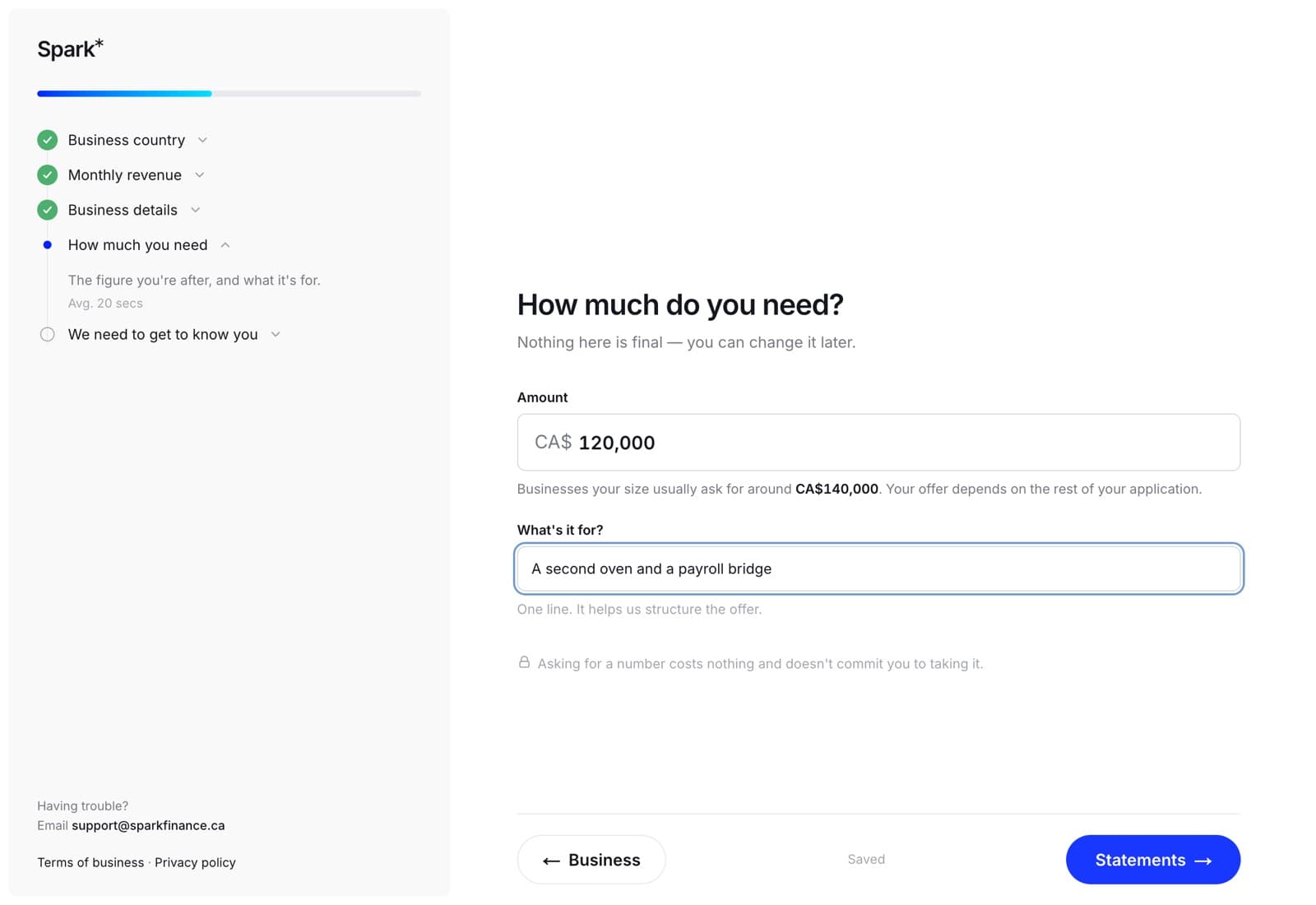
Any of these is one sentence in the box that asks what the money is for.
Said on the way in it costs you nothing. Found in the statements by somebody who then has to ask, it costs a day.
Questions
No. Seasonality is expected in food service and it is read in context. What matters is what the quiet months look like relative to the busy ones, not that they exist.
Still deciding? Talk to a specialist — no application required.
Worth reading next
- GuideWhat working capital actually costsHow to read a funding offer in dollars instead of rates, and the three numbers that decide whether it is worth taking.
- WritingWhat an underwriter is looking forThe eight things a person actually checks on your file, in the order they check them, and what each one is really asking.
Other trades
See what you qualify for.
About ten minutes, most of it finding your statements. Applying never touches your credit score.